
Where Plants Get Loud, Weird, and Wonderfully Informative
🌵 The Wild Wonders Blog
Welcome to the official blog of Wild Wonders Oasis—your go-to source for quirky plant facts, expert care tips, behind-the-scenes nursery peeks, and the occasional cactus with a superiority complex.
Here, we dig into everything from caudiciform oddities and carnivorous plant drama to succulent styling hacks and seasonal care advice. Whether you're a seasoned collector or a new plant parent just trying to keep things alive, we’ve got dirt you’ll want to read.
🪴 New posts sprouting regularly.
Grab your watering can—and your sense of humor—and let’s grow wild together.
Sundew Species Guide: Which Drosera Is Right for You?
The Most Diverse Carnivorous Plant Genus
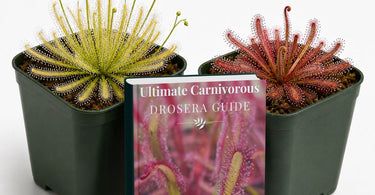
With over 200 species found on every continent except Antarctica, Drosera is the largest genus of carnivorous plants. They range from tiny pygmy rosettes the size of a coin to sprawling fork-leaved giants with leaves over a foot long. All share the same basic mechanism — sticky, gland-tipped tentacles that trap and digest insects — but their care requirements, appearance, and growth habits vary considerably. Here's a guide to the most popular groups.
Cape Sundews (Drosera capensis complex) — Best for Beginners
The Cape Sundew is the gateway drug of carnivorous plants, and for good reason. Native to the Cape region of South Africa, D. capensis is fast-growing, prolific, forgiving of imperfect conditions, and produces long strap-shaped leaves covered in vivid red tentacles. It doesn't require dormancy, tolerates a wide range of temperatures, and self-seeds prolifically.
Care highlights: Bright indirect to direct light, tray method with distilled water, no dormancy required, 60–85°F.
Available varieties:
- Drosera capensis 'Cape Sundew' — the classic green form with red tentacles
- Drosera capensis 'Mini Red' — compact ruby-red form, great for small spaces
- Drosera capensis 'Octopus' — unusually long tentacles for dramatic effect
Fork-Leaved Sundews (Drosera binata complex) — Best for Impact
Fork-leaved sundews produce tall, dramatically branched leaves that fork repeatedly — some forms producing dozens of sticky tips per leaf. They're larger than Cape Sundews, equally easy to grow, and incredibly effective at catching insects. A mature clump in full sun is one of the most striking carnivorous plants you can grow.
Care highlights: Full sun preferred, tray method, some forms benefit from a mild winter rest (reduce watering, cooler temps), 55–90°F.
Available varieties:
- Drosera binata 'Marston Dragon' — large, multi-forked leaves with dragon-like form
- Drosera binata var. dichotoma — classic forked form, vigorous grower
Rosetted Sundews — Best for Terrariums
Rosetted sundews form flat, circular rosettes that hug the ground. Species like D. spatulata, D. tokaiensis, and D. aliciae are compact, attractive, and well-suited to terrarium growing. They're slightly more sensitive than Cape Sundews but still beginner-friendly.
Care highlights: Bright indirect light, high humidity appreciated, tray method, no dormancy for most species.
Best for: Terrariums, windowsill collections, anyone who wants a tidy, compact plant.
Pygmy Sundews — Best for Collectors
Pygmy sundews are a fascinating group of miniature Australian species, most growing no larger than a 50-cent piece. They produce tiny gemmae (vegetative buds) in winter that can be used for propagation — a unique feature in the plant world. They require more specific care than Cape Sundews but are highly rewarding for collectors.
Care highlights: Bright light, very well-draining media, cool winters (they're from Mediterranean-climate Australia), low to moderate humidity.
Best for: Experienced growers, collectors, anyone fascinated by miniature plants.
Tuberous Sundews — Advanced Growers Only
Tuberous sundews are Australian species that grow from underground tubers, going completely dormant in summer (their dry season) and emerging in fall. They're among the most spectacular sundews — some producing tall, climbing stems — but require very specific seasonal care and are not recommended for beginners.
Tropical Sundews (Drosera adelae, D. schizandra, D. prolifera)
These Queensland rainforest species prefer shadier, cooler, and more humid conditions than most sundews — the opposite of the typical "full sun" advice. They're slow-growing but beautiful, and thrive in terrariums with high humidity and indirect light.
Quick Comparison
| Group | Size | Difficulty | Dormancy? | Best Feature |
|---|---|---|---|---|
| Cape Sundews | Medium | Easy | No | Fast growth, forgiving |
| Fork-leaved | Large | Easy | Mild rest | Dramatic form, high yield |
| Rosetted | Small-Med | Easy-Mod | No | Compact, terrarium-friendly |
| Pygmy | Tiny | Moderate | Yes (gemmae) | Collectible, unique |
| Tuberous | Varies | Advanced | Yes (summer) | Spectacular, rare |
| Tropical | Medium | Moderate | No | Shade-tolerant, lush |
Our Recommendation
Start with a Cape Sundew — ideally the Sundew Collector Bundle to get multiple varieties at once. Once you're comfortable with the basics, add a fork-leaved species for drama and a rosetted species for your terrarium.
Shop Sundews
Featured Collection


