Congrats, you rule-breaker. No soil. No drama.
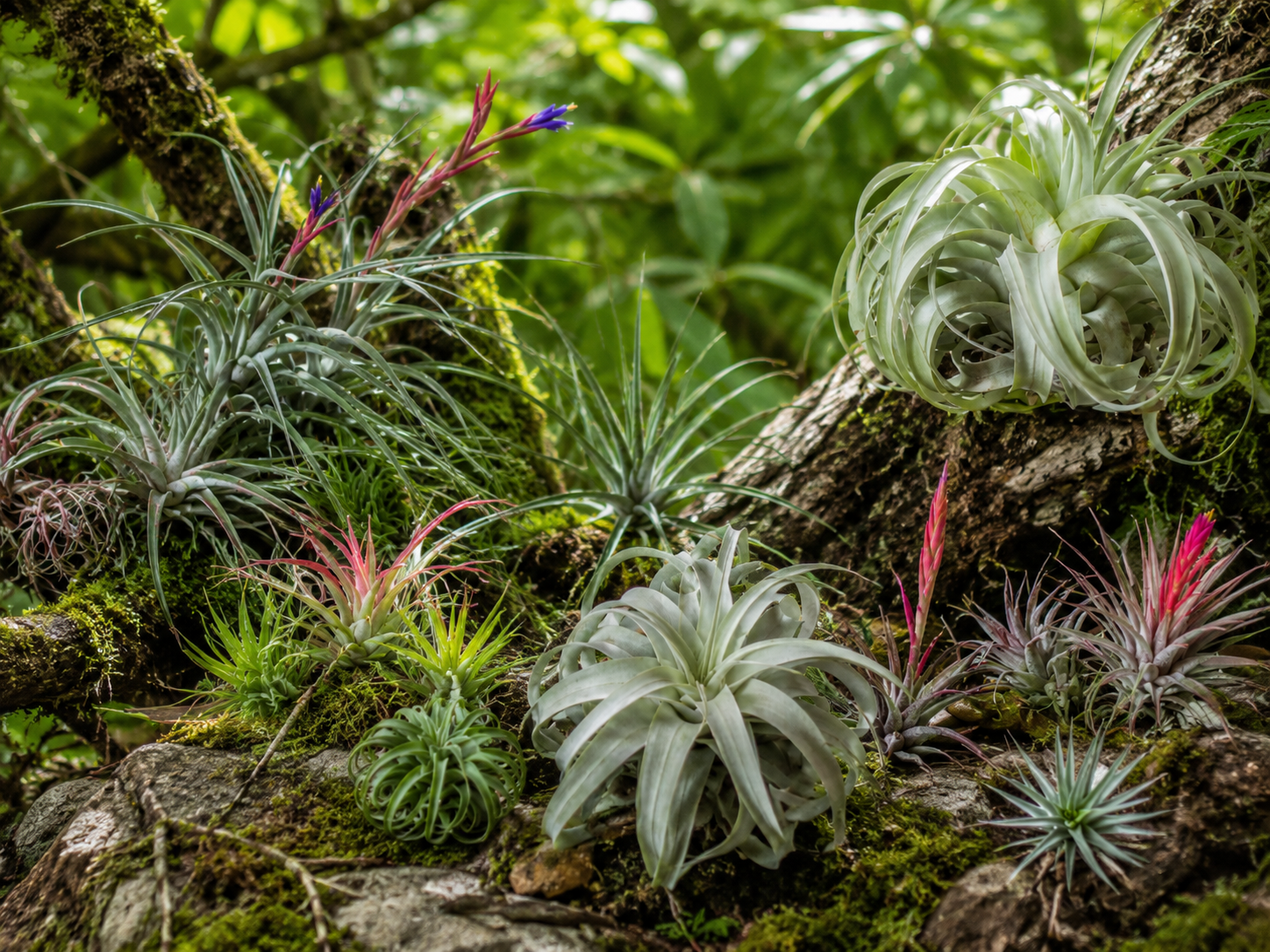
You adopted a floaty little weirdo that looks like it came from a sci-fi terrarium. Air plants (Tillandsia) are bromeliads that drink through their leaves, not their roots — they grow on trees, rocks, shells and basically anywhere they feel like. And now, your shelf.
Shipped in a box we'd trust with our own plants — see how we pack. Covered by the 48-hour Live Arrival Guarantee.
The three ways people kill an air plant
Avoid these three and you're already ahead of most of the internet.
-
Planting it in soil
It's an air plant. Soil holds water against the base and the plant rots from the bottom up.
Instead: Perch it on driftwood, a shell, a crystal cluster or a wire holder. Roots are for gripping, not drinking.
-
Letting it sit wet in a closed vessel
Water pooled in the base plus no airflow equals rot in days. Sealed terrariums are the usual culprit.
Instead: After soaking, shake it out upside down and let it dry completely in a breezy spot before it goes back in anything.
-
Tap water and dark corners
Softened or heavily treated tap water scorches the leaf tips; a dim corner slowly starves it. Even goth plants need light.
Instead: Distilled, rain or filtered water. Bright, indirect light — a bright windowsill, grow light or shady patio.
🌬️ Air plant 101: the basics
Four rules. The fourth one is the one everyone forgets.
☀️ Light
Bright, indirect light is the sweet spot. Too much direct sun = crispy tips. Too little = sad, floppy vibes. Fuzzy silver types take more light than smooth green ones.
💧 Water
Yes, it needs water, even if it looks like it runs on good intentions. Soak 20–30 minutes once a week in room-temp distilled or rain water. Mist between soaks if your air is dry.
💨 Drying
Shake it off — gently, upside down — until nothing pools in the base. Dry fully in a breezy spot. Sitting water is the only thing that really kills these.
🪺 Display
Shells, driftwood, geometric holders, macramé nests. Keep it airy: no sealed glass, no terrariums without airflow, no soil. Ever.
Week one: the welcome routine
Air plants travel well — they just arrive thirsty.
Day 1
Unbox and soak
Unwrap gently and give it a 20–30 minute soak in room-temp distilled or rain water. It's been in a box for days; this is its welcome drink.
Day 1
Shake, then dry upside down
Shake it out gently and set it upside down in a breezy spot for a few hours until the base is bone dry. Then place it in its holder.
Days 2–7
Find its light
Bright, indirect. A bright windowsill, a grow light or a shady patio. If the tips crisp, pull it back a little; if it goes limp and dull, move it brighter.
Weekly
Soak, shake, dry. Repeat.
Once a week forever: soak 20–30 minutes, shake, dry fully. Mist between soaks when the heater's on. That's the whole routine.
Which floaty weirdo did you get?
Same routine, slightly different appetites.
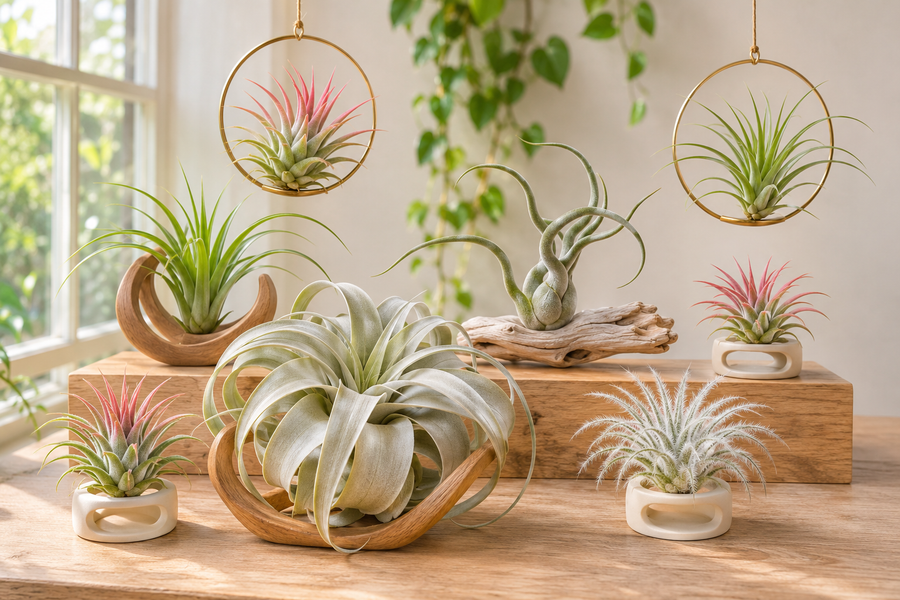
The queen of air plants. Big, swirly silver leaves and a rosette that commands attention. Dramatic, drought-tolerant and photogenic.
- Takes more light and less water than most — soak every 10–14 days is plenty.
- Shake out thoroughly; her deep rosette holds water.
- A shelf queen with zero shame.
The fuzzy desert dream. Covered in soft, snowy trichomes like a cloud that became a plant.
- Loves bright light and dry air — the fuzz is its sunscreen and sponge.
- Mist rather than soak; a long soak can flatten the fuzz.
- Touchably soft and totally low-maintenance.
Small but mighty. Blushes pink or bright red when it's about to bloom.
- Standard weekly soak, bright indirect light.
- Perfect for terrariums with airflow and tiny spaces.
- After blooming it pups — baby plants at the base you can separate or leave as a clump.
The Medusa and the alien. Twisting tentacle leaves on a bulbous base — straight out of mythology.
- The bulb traps water: shake extra well and dry upside down.
- Prefers misting plus a shorter soak.
- A conversation starter in any collection.
Is this normal? (Usually, yes.)
Travel fatigue looks alarming and fixes itself. Here's how to tell the difference between a shrug and a problem — and what to do about each.
Leaves are curling inward
Normal — it's thirsty. Curling and a dull look mean dehydration. Soak 30 minutes, shake, dry. It uncurls within a day.
The tips are a little brown
Usually normal. Dry tips come from low humidity or a bit too much sun. Trim them at an angle if you like, mist more often, pull back from direct light.
A few bottom leaves are dry and papery
Normal. Air plants shed from the base as they grow. Pull them off gently.
The base is soft, brown or falls apart
Not normal. That's rot from sitting wet. Nothing saves it once the core is gone. If it arrived that way, send photos within 48 hours and the Live Arrival Guarantee covers it.
What to send us if something's wrong
- Your order number
- A photo of the whole plant
- A close-up of the base
- Where it's sitting and how you've watered it
The more we see, the faster we can tell a shrug from a problem.

🟤 The dirt it wants
No dirt. That's the whole recipe.
Air plants are the one family that skips the soil guide entirely. What they want instead: a perch with airflow, pure water and bright indirect light. The gear below is about display and humidity, not dirt.
Perches, water and a little humidity
What we use at the nursery. Our own products first; the rest are the exact Amazon picks we've tested.
-
From our shop
 Cold weather
Plant Snuggie in a Packet — 72 Hour Shipping Heat Pack 🔥
72-hour heat pack for the next plant you order when it's under 50°F.
$6.50 View -
Affiliate · Amazon

-
Affiliate · Amazon
 Lighting
Adjustable small grow light
For windowsills that are more 'vibe' than 'sun'.
~$30 See on Amazon ↗ -
Affiliate · Amazon
 Monitoring
Humidity / temperature monitor
Stops the guessing. Put it next to the plant, not across the room.
~$12 See on Amazon ↗ -
Affiliate · Amazon
 Display
Glass cloche with air holes
A permanent mini-greenhouse that doesn't look like a seed tray.
~$30 See on Amazon ↗


Some links are affiliate links. If you buy through them we earn a small commission at no extra cost to you — it keeps the care guides free.
Seen it done once? It's easier.
Short care videos from the nursery. 22,000+ plant people already subscribe.
Your new plant need another buddy?


Arrives alive. Or we fix it.
A rumpled leaf after a cross-country road trip is normal. A plant that arrives in genuinely bad shape is not — and that one's on us.
- Unbox & look it over Bring it inside and check the base. Curled leaves are thirst; a soft brown base is not.
- Message us within 48 hours Order number + clear photos of the plant, the packaging and the shipping label.
- We sort it out Replacement or refund per the policy. No interrogation, no plant-shaming.
Keep the plant and packaging while we review. Full details in the policy.
Join the Wild Ones. It's free, and it's mostly humor.
The insider list for people who talk to their plants. Care tips you'll actually read, new arrivals before they hit the homepage, and the occasional subscriber-only deal.
- Every quick-start, soil recipe and video, free
- New arrivals and rare drops announced to you first
- One email a week, max. We're busy watering.
No spam. Unsubscribe whenever. Your plants will understand. See all four tiers
🎁 There's a discount code in your box
Float freely. Mist regularly. Flex your foliage.
There's a 10% code in your box. Grab another air plant to build your throne, or start a collection with the top five — you know you want to. Welcome to the no-dirt life. Your shelf has never looked better.